
Organizations that are just starting their data journey are facing challenges related to new technology and new practices, and often new ways of doing business. At the other end of the spectrum, many organizations are well along their journey to establishing mature data practices and have now embarked on a “digital transformation” initiatives that are demanding “next level” data management.
Regardless of where you are in the journey, change management is always a challenge. Baselining your capabilities gives leadership a sense of the organization’s existing knowledge, practices, tooling and momentum. This provides a solid foundation from which to build the strategy and execution approach captured in a roadmap.
The Data Reach approach to baselining data capabilities is foundationally based on the industry best practices frameworks captured in the ISACA / CMMI Data Management Maturity Model (DMM), and the Enterprise Data Management Council’s Data Capability Assessment Model (DCAM). We are certified in both models. While the Data Reach team can provide an official benchmarked score, most engagements use the models as a way to understand strengths, weaknesses, and practices of critical important that are success factors for the organization.
Where required, these frameworks are aligned with other industry domain standards, or best practices as appropriate; below are some of the complimentary standards that we have aligned to.
- Personal Information Protection (CCPA, GDPR are examples)
- Information Security (ISO 27001, NIST 800-53 are examples)
- Risk & Controls (SOC 2)
- Supply Chain (SCOR & APQC are examples)
- Banking (BCBS 239; CCAR are examples)
Our approach:
- Promotes collaboration across the organization
- Produces results rapidly and with minimal time requirements from the organization
- Ensures alignment to business priorities
- Identifies pain points holding back the organization, and
- Those practices that the business considers critical to success
- Establishes the control framework to be applied periodically to assess progress
Generally, we like to engage in a series of workshops. However, there are occasions where we use on line surveys as a way to gather initial data.
The strategy and roadmap are grounded in the findings from our capability baseline. The process builds on these to identify an initial operating model that defines how all parties work together, the management and governance framework, critical success metrics, and required tooling.
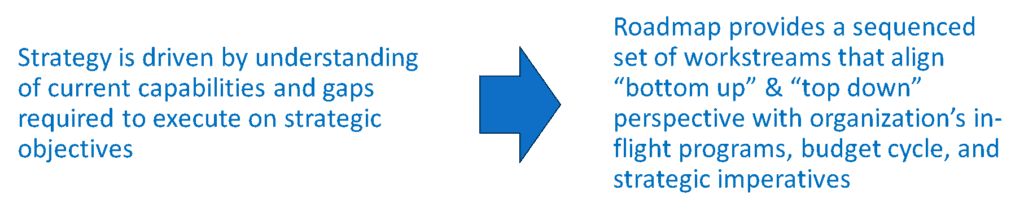
Our Approach: Keep it agile and phased; establish gates that manage risk and allow for a change in course, and ensure operational relevance.
- Not all data is important – focus on the important data that drives performance metrics and is critical to delivering on the core mission
- Community is key – Building the data culture that identifies the data people – those that “get it” is a critical success factor impacting packaging of the value proposition, the alignment of data to operations, and the ability to creatively collaborate across silos to solve problems.
- Fit the Plan and Roadmap to where organization is on the Journey – There are many ways to execute on change and each organization is different. Aligning the roadmap to the culture, the budget, in – flight programs, and realities of the organization’s industry all influence the path forward.
